Getting an Amazon job without previous experience may seem difficult, especially when many job descriptions ask for Seller Central knowledge, product research, or e-commerce experience. However, beginners can still enter the field by learning the right skills, building a small portfolio, and applying for entry-level positions.
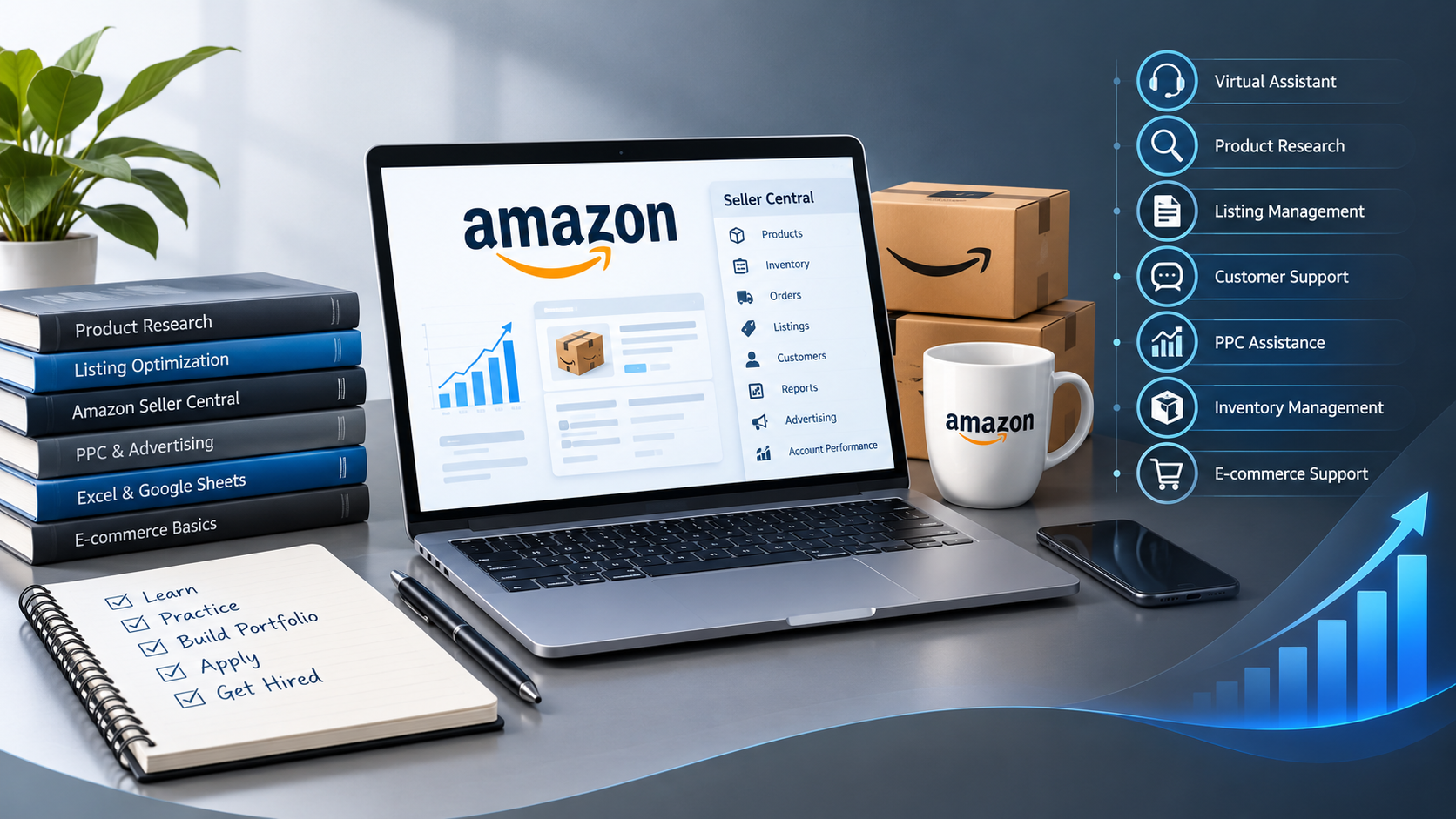
Amazon-related jobs are available across areas such as virtual assistance, product research, listing management, customer support, inventory, and PPC assistance. In Pakistan, current Amazon job opportunities also show opportunities for fresh candidates and people willing to learn.
The key is to focus on what employers need rather than only focusing on the fact that you have no previous job experience.
What Is an Amazon Job?
An Amazon job can refer to several different roles that support sellers and e-commerce businesses on Amazon.
Some common entry-level roles include:
| Amazon Virtual Assistant |
| Amazon Product Researcher |
| Amazon Listing Assistant |
| Amazon Customer Support Assistant |
| Amazon PPC Assistant |
| Amazon Account Assistant |
| E-commerce Assistant |
| Amazon Wholesale Assistant |
Many of these roles involve working with Amazon Seller Central, researching products, updating listings, monitoring orders, preparing reports, or supporting day-to-day store operations.
You do not necessarily need to be an experienced seller to start. However, you should understand the basics of the Amazon marketplace and be able to demonstrate that you can perform the tasks required for the role.
Explore marketplace management to understand the wider range of activities that support online sellers.
Can You Get an Amazon Job Without Experience?
Yes. Some employers specifically consider fresh graduates or candidates with limited experience.
For example, current Pakistan job listings include fresh Amazon VA positions where candidates are encouraged to apply and are expected to have basic knowledge of Amazon Seller Central and e-commerce. Other listings state that fresh candidates with strong computer skills and a willingness to learn may be considered.
This means you do not always need years of experience before applying.
Instead, employers may look for:
| Basic Amazon knowledge |
| Good computer skills |
| Research ability |
| Communication skills |
| Attention to detail |
| Excel or Google Sheets knowledge |
| Willingness to learn |
| Ability to follow instructions |
| Basic understanding of e-commerce |
Step 1: Learn How Amazon Works
Before applying for jobs, understand the basics of the Amazon marketplace.
You should know what:
- Amazon Seller Central is
- FBA and FBM mean
- Product listings are
- Product research involves
- Keywords are
- Amazon PPC is
- Inventory management means
- Customer reviews and ratings are
- Orders and returns are handled
You do not need to become an Amazon expert immediately. Start with the fundamentals and gradually move toward practical skills.
NAVTTC currently lists Amazon Virtual Assistant training as a three-month Information Technology course, and its curriculum covers areas such as Amazon product research, sourcing, listings, logistics, PPC, Seller Support, FBM, wholesale, and freelancing.
For a broader overview of the career path, read our guide to Amazon Virtual Assistant jobs.
Step 2: Learn Amazon Seller Central
Seller Central is one of the most important platforms to understand if you want to work with Amazon sellers.
Learn how sellers use it to manage areas such as:
- Products
- Inventory
- Orders
- Listings
- Customers
- Reports
- Advertising
- Account performance
You may not have access to a real Seller Central account as a beginner. That is okay.
You can learn through tutorials, training programs, demonstrations, and practice exercises. The goal is to understand the interface and the basic processes before applying for jobs.
Step 3: Develop Product Research Skills
Product research is one of the common responsibilities associated with Amazon VA roles.
A beginner should understand how to research products based on factors such as:
- Demand
- Competition
- Selling price
- Reviews
- Product size
- Estimated sales
- Profit potential
- Keywords
- Existing competitors
You should also learn how to organize research in Excel or Google Sheets.
For example, create a sample spreadsheet containing 10 products. Include the product name, estimated price, number of reviews, competitors, keywords, and your observations.
This simple exercise can become part of your portfolio.
Step 4: Learn Amazon Listing Basics
Amazon listings need more than just a product name and picture.
Learn the basics of:
- Product titles
- Bullet points
- Product descriptions
- Backend keywords
- Images
- Search terms
- Basic Amazon SEO
Practice by choosing an existing product and creating a sample optimized listing.
Clearly label it as a practice project. You do not need to pretend that you worked for a real Amazon seller.
Understanding marketing and SEO can also help you understand how product content is structured for visibility.
Step 5: Improve Your Excel and Google Sheets Skills
Basic data handling is useful for many Amazon jobs.
You should be comfortable with:
- Creating spreadsheets
- Sorting and filtering data
- Basic formulas
- Organizing product information
- Creating simple reports
- Comparing products
- Tracking inventory
You do not need advanced data analytics skills for an entry-level position. Start with the functions that are commonly used for everyday e-commerce work.
Step 6: Build a Portfolio Without Having a Job
One of the biggest problems for beginners is the question:
The answer is to create practical sample work.
Your portfolio could include:
Product Research Sample
Research 10 potential products and explain why you selected them.
Listing Optimization Sample
Take a publicly available product and create an improved sample title, bullet points, description, and keyword list.
Competitor Analysis
Compare three competing products and identify their pricing, reviews, features, and listing strategies.
Keyword Research
Create a spreadsheet of relevant keywords for a sample Amazon product.
PPC Research
Prepare a basic sample PPC keyword list and organize keywords by relevance.
These projects demonstrate your ability better than simply writing “Amazon VA” on your CV.
Step 7: Take an Amazon or E-commerce Course
A structured course can help you learn faster, especially if you are completely new to Amazon.
NAVTTC currently lists Amazon Virtual Assistant as a three-month course and also lists an Amazon VA hourly course outline.
However, completing a course does not automatically guarantee a job.
Use training to develop practical skills, then combine your learning with sample projects and a professional CV.
Step 8: Create a Beginner-Friendly CV
Your CV should focus on relevant skills rather than repeatedly saying that you have no experience.
For example, instead of:
Objective:
“I have no experience but want to work as an Amazon VA.”
Use:
Skills:
- Amazon Seller Central basics
- Product research
- Competitor analysis
- Amazon listing optimization
- Keyword research
- Basic Amazon SEO
- Excel and Google Sheets
- E-commerce fundamentals
If you have completed practical projects, add a Projects section to your CV.
This gives employers something concrete to evaluate.
Step 9: Apply for Internships and Junior Roles
Do not only search for jobs titled “Amazon Virtual Assistant.”
Also search for:
| Amazon VA Intern |
| Junior Amazon VA |
| E-commerce Assistant |
| Amazon Assistant |
| Product Research Assistant |
| Amazon Listing Assistant |
| E-commerce Intern |
| Amazon PPC Assistant |
| Marketplace Assistant |
Internships and training-based positions can be useful entry points.
Current Pakistan listings include fresh Amazon VA opportunities as well as broader virtual-assistant training programs for fresh graduates.
You can also explore Amazon VA jobs to learn more about this career path.
Step 10: Use LinkedIn and Job Platforms
Create profiles on platforms where employers advertise e-commerce jobs.
Useful places to search include:
- Indeed Pakistan
- Rozee.pk
- Company career pages
- Freelancing platforms
- Local e-commerce agencies
Search using different combinations of keywords. For example:
| “Amazon VA fresh” |
| “Amazon VA internship” |
| “Junior Amazon VA” |
| “Amazon assistant Pakistan” |
| “E-commerce assistant” |
You may find more opportunities by searching for related roles rather than using only one job title.
How to Get Your First Amazon Job Faster
Getting your first job is easier when you can demonstrate practical knowledge.
Follow a simple process:
Do not spend months collecting certificates without actually practicing.
For example, if you learn product research, create a product research spreadsheet. If you learn listing optimization, create a sample listing. If you learn PPC, prepare a basic keyword structure.
Your goal should be to turn learning into evidence of your skills.
What Employers May Ask in an Amazon Interview
Even for an entry-level position, you may be asked basic questions such as:
- What is Amazon Seller Central?
- What is FBA?
- What is FBM?
- How do you research a product?
- What makes a good Amazon listing?
- What are keywords?
- What is Amazon PPC?
- How would you analyze a competitor?
- How comfortable are you with Excel?
- How would you handle a customer or order issue?
You do not need to know everything.
If you do not know an answer, explain what you understand and show that you are willing to learn.
Common Mistakes Beginners Should Avoid
Applying Without Learning the Basics
Sending dozens of applications without understanding Amazon will make interviews difficult.
Claiming Fake Experience
Never claim that you managed an Amazon account if you did not.
Instead, show practice projects and explain exactly what you have learned.
Collecting Certificates Only
Certificates can support your CV, but practical knowledge is more useful during an interview.
Ignoring Communication Skills
Amazon VAs often communicate with clients, team members, suppliers, and customers. Clear written and spoken communication can therefore be important.
Customer communication skills can also be useful in customer support roles.
Applying Only for “Experienced” Roles
Do not limit your search to senior positions. Look for internships, junior positions, training programs, and entry-level e-commerce roles.
Final Thoughts
Getting an Amazon job with no experience is possible, but you still need relevant skills. The best way to start is to learn Amazon fundamentals, practice common tasks, build a small portfolio, and apply for entry-level roles.
You do not need to wait until you have a long work history to start. A strong combination of practical skills, sample projects, a focused CV, and consistent applications can help you move toward your first Amazon-related job.
For beginners in Pakistan, structured training options also exist, including NAVTTC-listed Amazon Virtual Assistant programs.
The goal is not to prove that you already know everything. It is to show employers that you understand the basics, can perform practical tasks, and are ready to learn.
Frequently Asked Questions
1. Can I get an Amazon job without experience?
Yes. Some entry-level and internship opportunities consider fresh graduates or candidates with limited experience. However, having basic Amazon and e-commerce knowledge can improve your chances.
2. What skills do I need for an Amazon job?
Useful beginner skills include product research, competitor analysis, listing optimization, keyword research, basic Amazon SEO, Excel or Google Sheets, communication, and general e-commerce knowledge.
3. Do I need a degree to become an Amazon VA?
Not always. Requirements vary by employer. Some positions may ask for a bachelor’s degree, while others focus more on practical skills and computer knowledge.
4. How can I get Amazon experience before getting a job?
Create sample projects such as product research reports, competitor analysis, keyword research, and sample Amazon listings. These can be included in a beginner portfolio.
5. Is Amazon VA a good career for beginners?
Amazon VA work can provide an entry point into e-commerce. With experience, a VA can move into areas such as account management, PPC, product research, wholesale, private label, or broader e-commerce operations.